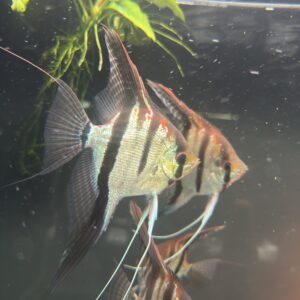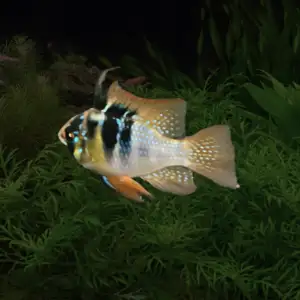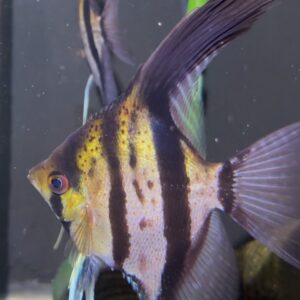
Ivanacara bimaculata – The Potaro Dwarf Cichlid from Guyana
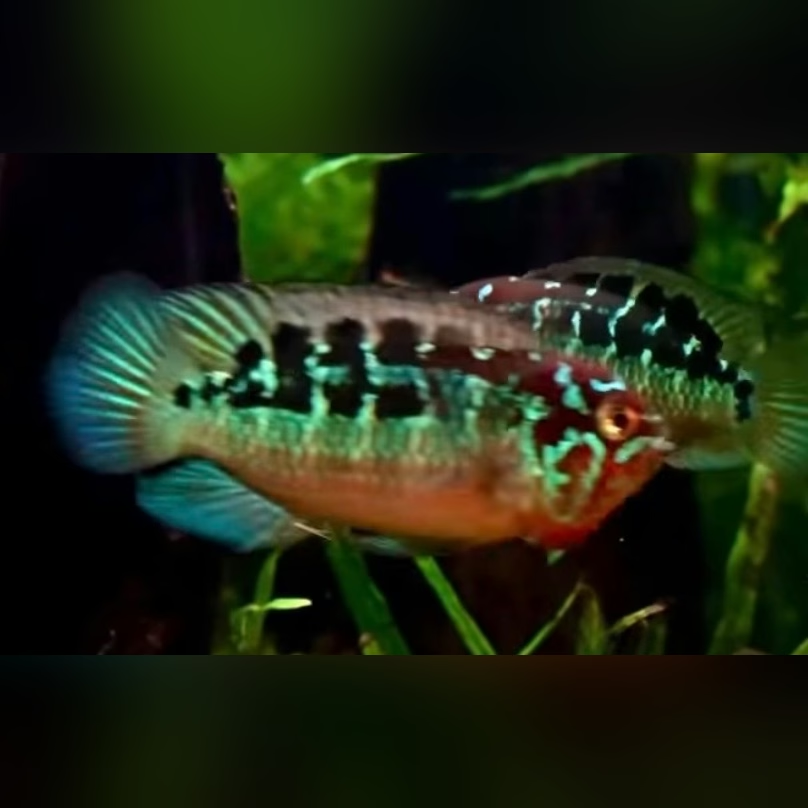
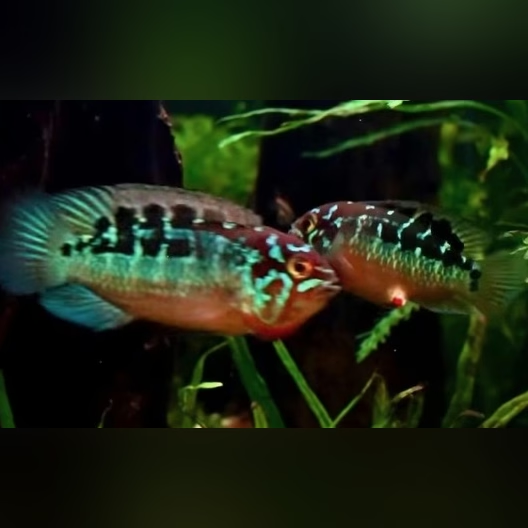
Among dwarf cichlids, the Ivanacara bimaculata is one of the few that manages to be genuinely colourful and genuinely easy at the same time. A mature male carries a deep red throat and cheek, an electric turquoise flank scattered with metallic scales, and a bold row of black blotches along the midline – a combination usually reserved for far more demanding species. It comes from the upper Potaro and Essequibo drainages in Guyana, in blackwater so remote that the species reached the hobby late and still appears only occasionally. Described by Eigenmann in 1912 as Nannacara bimaculata and moved to Ivanacara by Römer and Hahn in 2006, it stays under two inches fully grown and is noticeably more forgiving than its better-known relative Ivanacara adoketa.
Ivanacara bimaculata Key Features
-
Red Face, Turquoise Body: Mature males show a red throat and cheek against a metallic blue-green flank. Colour intensifies with maturity, good water and dim, blackwater-style lighting.
-
Two-Spot Pattern: A bold row of black blotches runs along the midline – the marking the species name bimaculata refers to. It shifts with mood and can fade almost completely on a stressed fish.
-
Small Even Fully Grown: Reaches just 4.5 cm (1.8 in) standard length at adult size. The Small grade offered here is a juvenile, so expect a considerably smaller and paler fish than the photographs show.
-
Easier Than Ivanacara adoketa: Not picky about food, less demanding about water than its Rio Negro relative, and a reasonable first dwarf cichlid for someone stepping up from tetras.
-
Tank-Bred Stock: These are captive-bred, not wild imports from Guyana. They already accept prepared foods and tolerate a wider range of water chemistry than wild-collected fish.
Ivanacara bimaculata Care Requirements
-
Tank Size: Minimum 15 gallons (60 litres) for a bonded pair; 25 gallons (100 litres) or more if you want them in a community. Floor area and hiding places matter more than water volume.
-
Water Temperature: 75–82°F (24–28°C). Tank-bred fish handle the whole of that range comfortably.
-
pH Range: 4.5–6.5 in the wild, soft and strongly acidic. Captive-bred stock adapts up to around neutral, but colour and breeding behaviour are best in soft, tannin-stained water.
-
Diet: Omnivorous and undemanding – one of the easier dwarf cichlids to feed. Quality micro-pellets or crushed flake as the base, with frozen bloodworms, daphnia and brine shrimp several times a week to bring out the red.
-
Tank Mates: Peaceful outside of spawning. Small tetras, pencilfish and corydoras all work well. Give a pair their own caves and sightline breaks – a spawning pair will defend a small territory, though they are far less aggressive than most cichlids.
Why Choose Our Ivanacara bimaculata
Dwarf cichlids are sold small and unremarkable-looking, and a badly conditioned juvenile never develops the colour that makes the species worth keeping. At Amazonia Tropical Fish LLC, our Ivanacara bimaculata undergo a rigorous, multi-week quarantine process. They are prophylactically treated for internal and external parasites and are verified to be eating well before they are ever offered for sale. You are receiving premium, stabilized stock.
Shipping & Live Arrival Guarantee
We safely ship these dwarf cichlids nationwide from our US-based facility using specialized, insulated packaging. Every order is fully covered by our Live Arrival Guarantee.
![Apistogramma cacatuoides "Double Red" [female only ]](https://amazoniafish.com/wp-content/uploads/2025/10/apistogramma-cacatuoides-double-red-01-300x300.avif "apistogramma-cacatuoides-double-red-01")